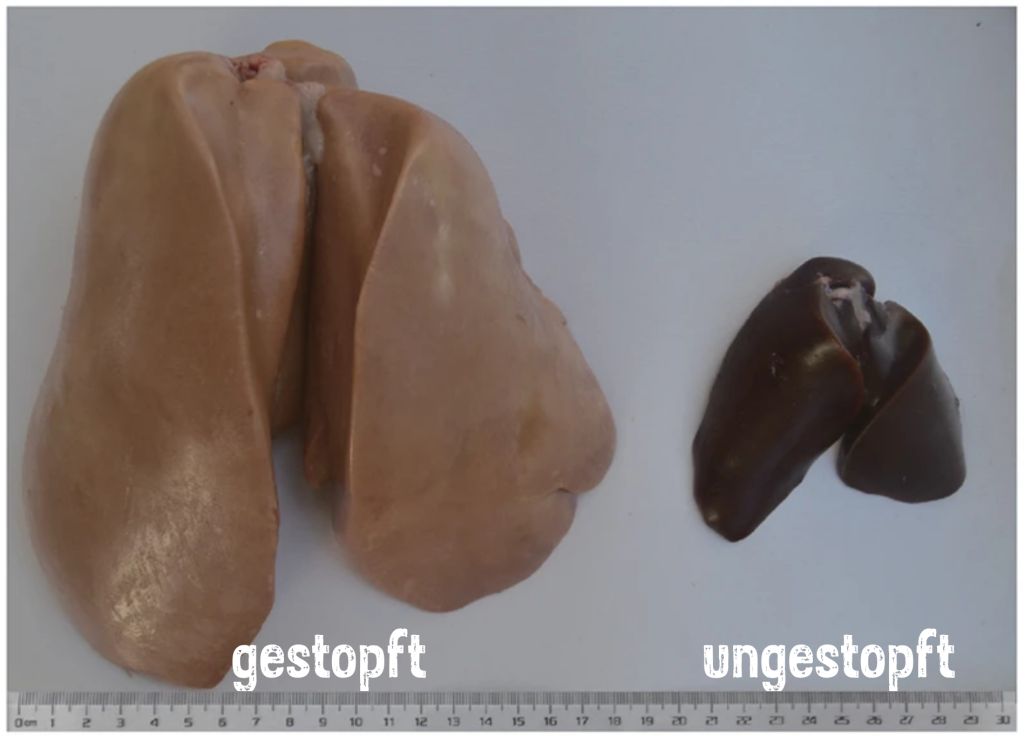
Liu, L. et al. (2016)18
Ablauf
Stopfleber ist eine krankhaft vergrößerte Leber von Enten oder Gänsen. Den Tieren wird mehrmals täglich ein langes Rohr tief in die Speiseröhre gesteckt, um ihnen gewaltsam bis zu 1,6 kg Maisbrei3,8,15 in ihre Mägen zu pumpen. Das ist, als würde man 15 kg Nahrung in einen Menschen pressen [s. eigene Berechnung]. Dadurch vergrößert sich die Leber auf das bis zu Neunfache ihres Normalgewichts5 und macht teilweise über 10 % des Körpergewichts3, 4, 7, 8, 9, 13 aus.
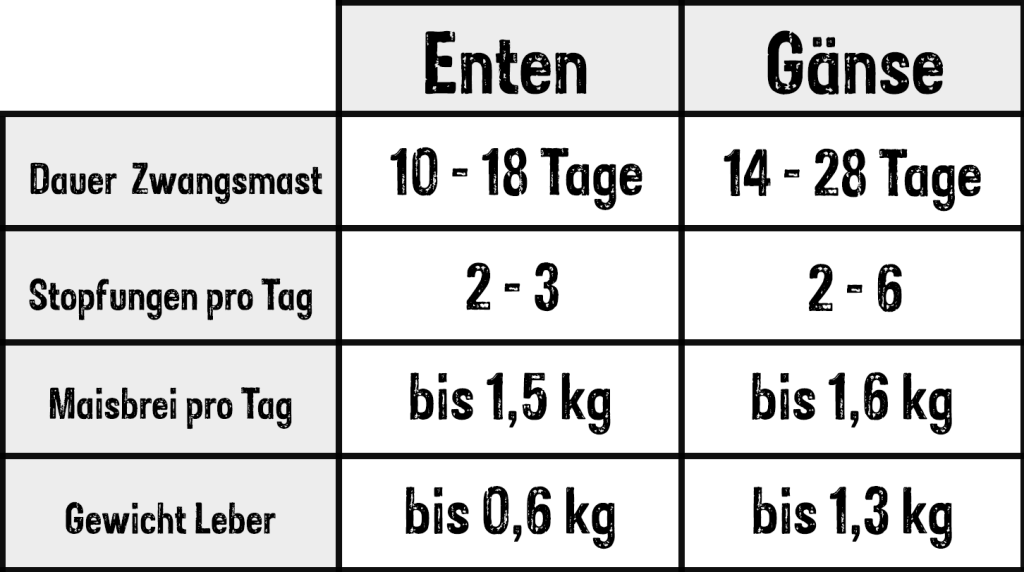
(Angaben aus Quellen 1 bis 9 (Gänse) und 10 bis 16 (Enten))
Gesetz
Das Tierschutzgesetz (§3 Abs. 9, damals Abs. 7) besagt seit dem 1. Oktober 197219:
„Es ist verboten einem Tier durch Anwendung von Zwang Futter einzuverleiben […]“
Das Zwangsmästen ist in nur 5 von 27 EU-Mitgliedstaaten erlaubt20: Frankreich, Ungarn, Spanien, Bulgarien und Belgien. Aufgrund der Warenverkehrsfreiheit des EU-Binnenmarktes darf Stopfleber jedoch leider nach Deutschland eingeführt und hier vermarktet werden. So können in Deutschland ansässige Restaurants, Feinkostläden etc. die bei uns verbotene Tierquälerei im Ausland durchführen lassen.
Deine Hilfe
Protestiere mit uns! Lass Unternehmen wissen, dass die Herstellung von Stopfleber grausam ist und bitte sie darum, keine zu verkaufen.
Quellen
[1] Gerzılov, V., & Petrov, P. (2014). Meat Characteristics, Fatty Liver Weight and Blood Biochemical Parameters in Force-Feeding Geese. Turkish Journal of Agricultural and Natural Sciences, 1(Özel Sayı-1), 802-804. https://izlik.org/JA42YX45DZ
[2] Xu, H., Wang, Y., Han, C., Jiang, L., Zhuo, W., Ye, J. & Wang, J. (2010). Estimation of Lipoprotein-lipase Activity (LPL) and Other Biochemical Changes in Two Breeds of Overfeeding Geese. Asian-Australasian Journal Of Animal Sciences, 23(9), 1221–1228. https://doi.org/10.5713/ajas.2010.10013
[3] Liu, X., Li, P., He, C., Qu, X. & Guo, S. (2020). Comparison of overfed Xupu and Landes geese in performance, fatty acid composition, enzymes and gene expression related to lipid metabolism. Asian-Australasian Journal Of Animal Sciences, 33(12), 1957–1964. https://doi.org/10.5713/ajas.19.0842
[4] Fernandez, X., Lazzarotto, V., Bernadet, M. & Manse, H. (2019). Comparison of the composition and sensory characteristics of goose fatty liver obtained by overfeeding and spontaneous fattening. Poultry Science, 98(11), 6149–6160. https://doi.org/10.3382/ps/pez289
[5] Mourot, J., Guy, G., Peiniau, P. & Hermier, D. (2006). Effects of overfeeding on lipid synthesis, transport and storage in two breeds of geese differing in their capacity for fatty liver production. Animal Research, 55(5), 427–442. https://doi.org/10.1051/animres:2006027
[6] Wei R, Ye F, He F, Song Q, Xiong X, Yang W, Xu H, Li L, Liu H, Zeng X, Chen L and Han Ch (2020). Comparison of Overfeeding Influence on Slaughter Performance, Small Intestinal Physiology and Microbiota between Gang Goose and Tianfu Meat Goose. J. World Poult. Res., 10 (2): 348-358. DOI: https://dx.doi.org/10.36380/jwpr.2020.40
[7] Gu, W., Wen, K., Yan, C., Li, S., Liu, T., Xu, C., Liu, L., Zhao, M., Zhang, J., Geng, T. & Gong, D. (2020). Maintaining intestinal structural integrity is a potential protective mechanism against inflammation in goose fatty liver. Poultry Science, 99(11), 5297–5307. https://doi.org/10.1016/j.psj.2020.08.052
[8] Fournier, E., Peresson, R., Guy, G. & Hermier, D. (1997). Relationships between storage and secretion of hepatic lipids in two breeds of geese with different susceptibility to liver steatosis. Poultry Science, 76(4), 599–607. https://doi.org/10.1093/ps/76.4.599
[9] Zhang, J., Wang, Q., Zhao, X., Wang, L., Wang, X., Wang, J., Dong, B. & Gong, D. (2017). MicroRNA-122 targets genes related to goose fatty liver. Poultry Science, 97(2), 643–649. https://doi.org/10.3382/ps/pex307
[10] Bernardi O, Reverchon M, Rame´ C, Glaveli EZ, Re´ mignon H, Froment P and Dupont J (2026). Dynamics and reversibility of hepatic steatosis in male Mule duck. Front. Physiol. 17:1804237. https://doi.org/10.3389/fphys.2026.1804237
[11] Guemene, D., Guy, G., Mirabito, L., Serviere, J. & Faure, J. (2007). Bien-être et élevage des palmipèdes. INRAE Productions Animales, 20(1), 53–58. https://doi.org/10.20870/productions-animales.2007.20.1.3435
[12] Awde, S., Marty-Gasset, N., Wilkesman, J. & Rémignon, H. (2013). Proteolytic activity alterations resulting from force-feeding in Muscovy and Pekin ducks. Poultry Science, 92(11), 2997–3002. https://doi.org/10.3382/ps.2013-03195
[13] Gerzilov, V., Petrov, P. B. . & Bochukov, A. (2013). EFFECT OF FORCE-FEEDING ONFATTY LIVER AND SERUM BIOCHEMICAL PARAMETERS IN MULE DUCKS. AgroLife Scientific Journal, 2(1), 193–196. https://doi.org/10.17930/agl2013131
[14] Wen, Z., Jiang, Y., Tang, J., Xie, M., Yang, P. & Hou, S. (2016). Effect of feed consumption levels on growth performance and carcass composition during the force-feeding period in foie gras production of male Mule ducks. Animal, 10(9), 1417–1422. https://doi.org/10.1017/s175173111600032x
[15] P. Chartrin, M.D. Bernadet, G. Guy, J. Mourot, J.-F. Hocquette, N. Rideau, M.-J. Duclos, E. Baéza, Do age and feeding levels have comparable effects on fat deposition in breast muscle of mule ducks?, Animal, Volume 1, Issue 1, 2007, Pages 113-123, ISSN 1751-7311, https://doi.org/10.1017/S1751731107658029.
[16] Jia, H., Du, Z., Chen, Y., Zhu, Z., Yu, X., Li, A. & Huang, C. (2026). Effects of Force-Feeding on Liver Lipid Accumulation and Fatty Acid Profiles in Mule Ducks. Agriculture, 16(15), 1645. https://doi.org/10.3390/agriculture16151645
[17] Statistisches Bundesamt: Der Durchschnittsmensch in Deutschland ist 1,73 Meter groß und wiegt 78,3 Kilo. Zahl der Woche Nr. 23 vom 2. Juni 2026. https://www.destatis.de/DE/Presse/Pressemitteilungen/Zahl-der-Woche/2026/PD26_23_p002.html. (abgerufen am 04.10.2026)
[18] Liu, L. et al. (2016). Prosteatotic and Protective Components in a Unique Model of Fatty Liver: Gut Microbiota and Suppressed Complement System. Sci. Rep. 6, 31763; https://doi.org/10.1038/srep31763. Figure 1. Lizensiert unter CC BY 4.0. Zugeschnitten und beschriftet.
[19] Tierschutzgesetz vom 24. Juli 1972, BGBl. I 1972, S. 1277-1283, hier S. 1278f und 1283. https://www.bgbl.de/xaver/bgbl/start.xav?start=%2F%2F*%5B@attr_id=’bgbl172s1277.pdf’%5D. (abgerufen am 04.10.2026)
[20] European Commission (2023): Impact Assessment Report – Revision of EU marketing standards for agricultural products to ensure the uptake and supply of sustainable products. Commission Staff Working Document, SWD(2023) 97 final, Brussels, 21 April 2023. https://eur-lex.europa.eu/legal-content/EN/TXT/?uri=CELEX:52023SC0097. (abgerufen am 04.10.2026)
Eigene Berechnung
Werden 1,60 kg Nahrung in eine Gans mit einem Gewicht von 8,15 kg gepumpt3, so entspricht dies dem Verhältnis 1,60 kg / 8,15 kg = 19,63 %. Übertragen auf einen in Deutschland lebenden Menschen mit einem Durchschnittsgewicht von ca. 78,3 kg17 ergibt dies 78,3 kg * 19,63 % = 15,4 kg.